Have you ever stood in the drugstore aisle, staring at a massive wall of smiling models on cardboard boxes, wondering if you are about to make a brilliant choice or a terrible mistake? You are definitely not alone.
The temptation to dye your own hair is stronger than ever. Let's be honest, salon prices are getting out of hand. With the global hair color market hovering around 28 billion dollars, millions of us are choosing to skip the salon chair and take matters into our own hands.¹ But can you really get those rich, multi-dimensional results in your own bathroom? Or are you setting yourself up for an expensive rescue mission?
The world of DIY hair color has changed dramatically over the last few years. It is no longer just about cheap squeeze bottles that leave your hair feeling like straw. Today, we have smart devices, bonding treatments, and custom formulas mixed by real colorists. Let's take a look at the real pros and cons of popular at-home hair color kits so you can decide if you should dye it yourself or leave it to the professionals.
The DIY Hair Coloring Pros and Cons: What You Need to Know
Before you mix that developer and color, you need to weigh the trade-offs. What are you actually getting into? Have you thought about the long-term health of your hair?
Let's start with the good news. The benefits of coloring your hair at home are hard to ignore.
• Unbeatable cost savings: A single-process color at a decent salon can easily cost you 100 to 250 dollars. When you add the tip, it gets even higher. At-home kits usually cost between 10 and 30 dollars. If you color your hair every six weeks, doing it yourself saves you thousands of dollars a year.
• Flexibility and convenience: You do not have to call weeks in advance to book an appointment. You do not have to sit in a salon chair for three hours. You can apply your color at midnight in your pajamas while watching your favorite show.
• Better formulas: The box dye of today is vastly superior to the formulas from a decade ago. Many modern options are ammonia-free, low-odor, and packed with nourishing ingredients like natural oils and bond-builders that actually help protect your hair cuticle.
But it is not all perfect. The risks of DIY hair coloring are very real, and they can be tough to fix.
• One size fits all developers: Salon colorists customize the strength of the developer based on your hair type. Drugstore box dyes do not do this. They use strong, generic developers to make sure the color works on everyone, from fine blonde hair to coarse black hair. On fine or already damaged hair, this can cause serious structural damage.
• The buildup effect: A very common mistake is applying permanent color to your entire head every single time you touch up your roots. Over time, that pigment builds up on the middle and ends of your hair. This makes your ends look darker, duller, and oversaturated, which stylists call the reverse ombre effect.
• High risk of chemical disasters: Some things should never be attempted at home. If you want to go lighter, get highlights, or try a balayage, put the box down. Without a deep understanding of color theory, attempting to bleach your hair at home often results in patchy, brassy, or chemically fried hair.
Understanding the Best Home Hair Dye Options in 2026
If you decide to take the plunge, you need to know what you are buying. The market is shifting rapidly toward clean, damage-minimizing formulas. In fact, over 65 percent of consumers now actively look for ammonia-free or plant-based hair dyes.³
Before picking a box, you need to understand the three main types of color. Permanent dye opens your hair cuticle to deposit color deep inside, which is best for stubborn gray coverage but causes the most wear and tear. Demi-permanent dye lasts for about 24 to 28 washes and is much gentler because it does not penetrate the hair shaft as deeply. Semi-permanent dye is a temporary stain that coats the outside of your hair, washing out in a few weeks with zero damage.
Let's look at some of the most popular and innovative kits available today.
• L'Oreal Paris Colorsonic: This is a high-tech, smart handheld device that automatically mixes color and developer in a perfect ratio.⁴ It uses mess-free cartridges and oscillating bristles to apply the color evenly. Users love how clean and easy it makes root touch-ups, though some note the device can feel heavy and can snag if your hair is not perfectly detangled first.⁵
• Clairol ColorStrong: Released in early 2025, this is a major step forward for drugstore hair color.² It is a three-step bonding line infused with Alpha Hydroxy Acid to help rebuild your hair's internal structure while you color. It is vegan, ammonia-free, and great for hair that is already a bit damaged.
• eSalon Custom Hair Color: This service bridges the gap between the salon and your bathroom. You fill out a profile, upload photos, and a licensed colorist formulates a custom shade just for you. It is more expensive than drugstore options, but the personalization is hard to beat.
• Madison Reed Radiant Hair Color: This brand uses a smart two-step system. You apply permanent color to your roots and a gentle, semi-permanent gloss to your ends. This prevents the ends of your hair from getting over-processed and dark.
An Honest At-Home Hair Color Kit Review: Tips for Success
How do you actually get great results without making a massive mess? If you want to color your hair at home, you need to follow a few golden rules that professional stylists swear by.
First, do not skip the patch test or the strand test. It is tempting to skip this step, but allergic reactions to ingredients like PPD can be painful. Testing the dye on a small, hidden section of hair first also lets you see exactly how the color will turn out before you cover your whole head.
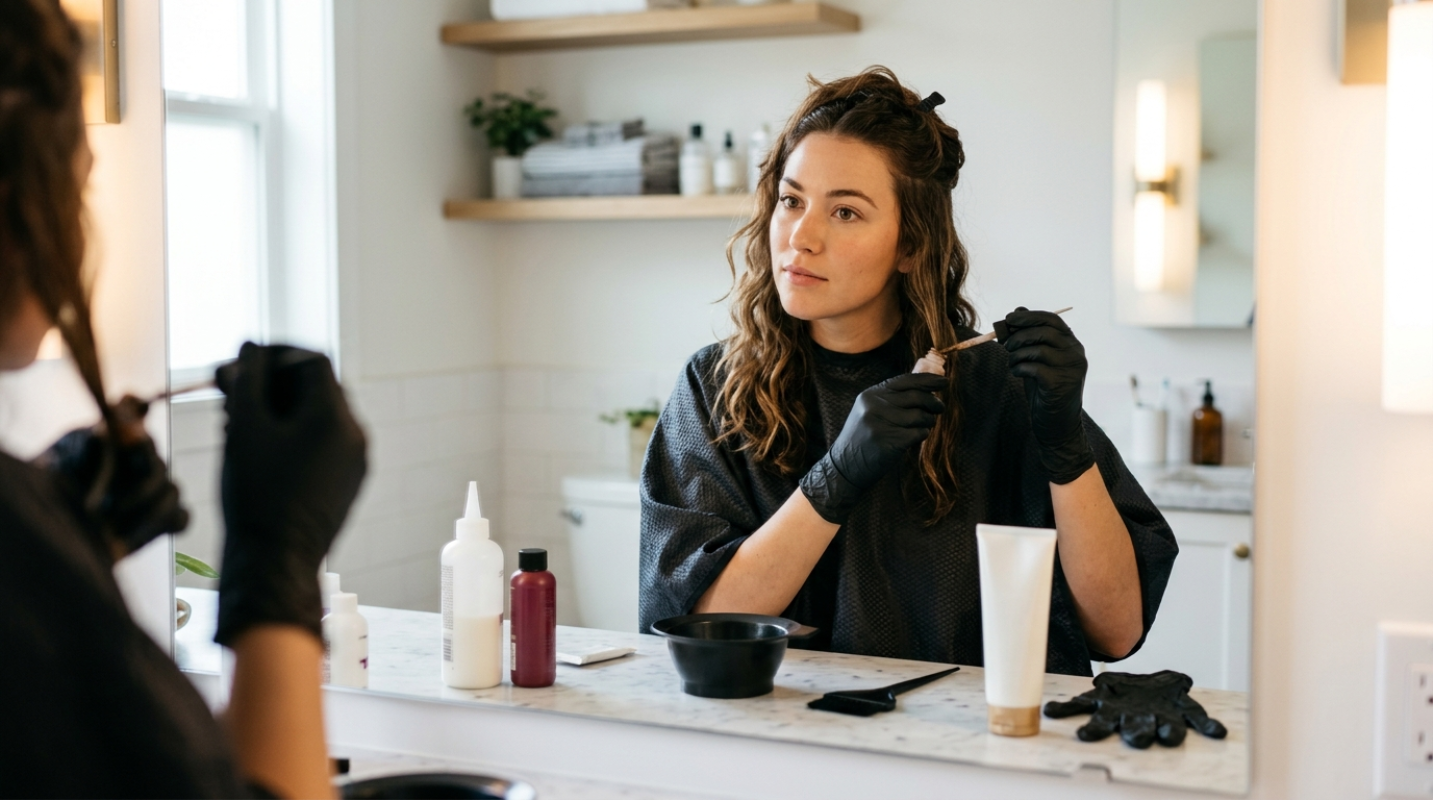
Second, section your hair properly. Do not just dump the bottle on your head and rub it in like shampoo. Divide your hair into four neat quadrants using plastic clips. Work in small, half-inch sub-sections to make sure every single strand gets evenly saturated with color.
Third, avoid hot roots. This happens when the heat from your scalp causes the dye near your roots to process much faster than the rest of your hair. The result is a bright, glowing crown that does not match your ends. To prevent this, apply the dye to your mid-lengths first if you are changing your color significantly, or stick strictly to your new growth if you are doing a touch-up.
When to Skip the Box and Call a Professional
As good as modern kits are, there are times when you must put the box down and call a professional. Knowing your limits will save your hair and your wallet.
You should always see a professional if you want to go more than two shades lighter than your natural color. Bleaching is a highly volatile chemical process that requires precise timing and application. If you try to go from dark brown to platinum blonde at home, you are highly likely to end up with orange hair, or worse, severe breakage.
You also need a pro if you are trying to correct a past color mistake. If your hair is currently patchy, green, or banded with different colors, do not try to fix it with another box of dye. You will only make the problem worse and make the eventual salon correction even more expensive.
Owning Your Look with Confidence
At the end of the day, at-home hair color kits are a fantastic tool if you use them wisely. They offer incredible convenience and can save you a massive amount of money. If you want to cover a few grays, touch up your roots, or go a shade or two darker, a modern DIY kit is a smart, budget-friendly move.
But if you want a dramatic change, hand-painted highlights, or a complex color correction, do not risk it. The money you save on a cheap box of dye is not worth the potential damage or the high cost of a professional fix.
Take your time, do your research, and always prioritize the health of your hair. With the right approach and a little patience, you can get a beautiful, shiny color right from the comfort of your own home.
Sources:
1. Fortune Business Insights: Hair Color Market Size
https://www.fortunebusinessinsights.com/hair-color-market-110594
2. GlobeNewswire: Clairol ColorStrong Launch
https://www.globenewswire.com/news-release/2025/01/28/3016497/0/en/clairol-unveils-its-first-ever-bonding-hair-color-line.html
3. Dataintelo: Hair Color Market Research
https://dataintelo.com/
4. Colorsonic: Colorsonic Hair Color Device
https://shop.colorsonic.com/products/colorsonic-hair-color-device?bvstate=pg:14/ct:r
5. GeekMamas: L'Oreal Colorsonic Review
https://geekmamas.com/2024/11/14/loreal-colorsonic-hair-color-device-review-does-it-really-work/